

Artificial Intelligence is transforming the way businesses operate. From streamlining repetitive tasks to improving productivity and decision-making, AI is becoming part of everyday business life.
But while organisations are exploring the opportunities AI brings, cybercriminals are doing the same.
The reality is that AI is not only changing how businesses work. It is also helping cybercriminals launch faster, smarter, and more convincing attacks. AI-assisted phishing, automated ransomware, and increasingly sophisticated attack methods are becoming a growing concern for organisations of all sizes.
Cybercriminals Are Using AI Too
Cybercrime is evolving faster than ever.
In the past, launching a successful cyberattack required significant time, resources, and technical expertise. Today, AI is helping attackers work faster, target organisations more effectively, and automate tasks that once took days or weeks.
Modern attacks can be more convincing, more personalised, and more difficult to detect. At the same time, attackers are reducing the time between gaining access to a system and causing disruption, leaving businesses with less time to respond. AI-assisted phishing and automated ransomware are now recognised as key elements of the modern threat landscape.
When Suspicious Emails No Longer Look Suspicious
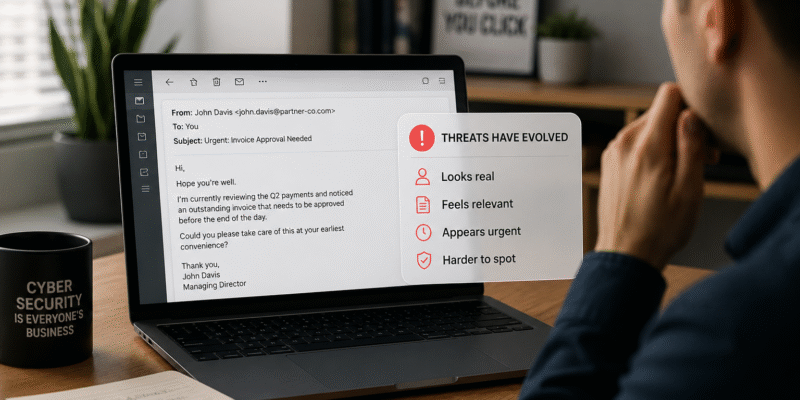
For years, employees were trained to identify phishing emails by looking for obvious warning signs such as poor grammar, unusual requests, or suspicious formatting.
That approach is becoming less effective.
AI can now generate highly polished, personalised communications in seconds. Messages can mirror writing styles, reference real-world events, and appear genuine enough to bypass traditional scepticism.
As AI-generated phishing becomes more sophisticated, businesses can no longer rely solely on employees spotting obvious red flags. Credential theft campaigns are becoming increasingly difficult to recognise, even for experienced users.
Training Staff Is No Longer Your Only Line of Defence
Security awareness training remains an important part of any cybersecurity strategy.
However, awareness alone is no longer enough.
Businesses need to assume that at some point:
- A phishing email may be opened
- A password may be compromised
- An attacker may gain access to an account or device
The organisations that respond most effectively are those that prepare for the possibility of an incident before it happens.
Prevention remains critical, but resilience, recovery, and business continuity are becoming equally important. As the threat landscape evolves, organisations must be able to detect, respond, and recover quickly when an attack occurs.
Five Questions Every Business Should Be Asking Right Now
As AI continues to reshape cyber threats, business leaders should ask themselves:
- Would we know if a user account was compromised today?
- How quickly could we contain a cyber incident?
- Are our backups tested and recoverable?
- Could we continue operating if key systems became unavailable?
- Do we have a documented recovery and business continuity plan?
These questions have moved beyond IT concerns. They are now business resilience questions that directly impact operations, revenue, customer trust, and long-term growth.
Building Resilience in an AI-Powered World
At EVAD, we’re seeing more organisations shift their focus from simply preventing attacks to building resilience against them.
Cybersecurity is no longer just about keeping threats out. It’s about ensuring your business can continue operating when the unexpected happens.
Through managed cybersecurity services, business continuity planning, backup and disaster recovery solutions, and ongoing strategic guidance, EVAD helps organisations strengthen their ability to prepare for, respond to, and recover from modern cyber threats. Our goal is simple: to help businesses remain secure, operational, and resilient in an increasingly complex digital environment.
The Real Question Isn’t Whether AI Will Affect Your Business
AI is already influencing how organisations work.
It is also influencing how cybercriminals operate.
The businesses that will thrive over the coming years will not be the ones that avoid AI. They will be the ones that embrace its benefits while putting the right security, recovery, and resilience measures in place.
The real question isn’t whether AI will affect your business.
It already is.
The question is whether you’re prepared for the risks that come with it.